Between November and December 2015, I was ceramic artist in residence as part of the Seto International Ceramics and Glass Art Exchange Program 2015.
I
regard my art practice as a form of research through which I interact with
particular sites, communities or historical museum collections. Taking part in
the programme enabled me to participate in a
community with a rich and living tradition of ceramics production.
All
over Seto, there are signs of its long and continuing engagement with clay and
ceramics. During the residency, my accommodation was located next to a clay
quarry and I used locally produced porcelain and red clay to make my work.
Abandoned, crumbling ceramics factories exist alongside going concerns, and
almost everywhere you go, broken sherds of pottery can be found under foot. On visiting
the excavated Konagaso kiln site, I was moved when I found fingerprints
impressed into a clay kiln support fired some 500 years old. While the often
heavily weathered buildings and shop signs were a nostalgic reminder of Seto’s
heyday, meeting artists and visiting factories showed that the city is still a
vibrant centre of making.
The Setomonogatari series was inspired by
this sense of continuity and change, particularly as expressed through material
culture and the built environment. Discarded ceramic objects have been
recovered and incorporated into new work. An old plaster mould has been reused,
bringing it back to life and highlighting its silent story of person-object
interaction. The three wall pieces were made with a plaster press mould taken
from a piece of rusty corrugated iron, a building material ubiquitous in Seto.
In creating a piece of ceramic art, we are making a material offering which has
the potential to endure into the future, intact or as sherds. I documented my
time in Seto through photography, often uploading images to Instagram. Many of
these photographs were used to make ceramic decals which decorate the works,
especially the porcelain pot and ema labels.
By turning this digital information into lasting, solid forms, I hope that
these works will preserve and tell the story of my time in Seto – my setomonogatari – as well as pay homage
to the place and its people.
私は、特定の場所・コミュニティ・美術館の歴史的収蔵品などと対話をする研究の一様式として、自分の作品制作を位置づけています。瀬戸国際セラミック&ガラスアート交流プログラムを通して、私は、陶磁器生産が盛んで現在も息づく伝統あるコミュニティに身を置く機会を得ることが出来ました。
瀬戸には、時代を通して常に土や焼き物との関わりがあった痕跡が、町中にあります。滞在期間中、私は粘土採掘場の隣にある寮に住み、地元のポーセリンと赤粘土で作品を作りました。稼働中の工場の脇に、打ち捨てられた崩れそうな製陶場があったり、どこへ行っても足元には壊れた焼き物のかけらがありました。小長曽陶器窯跡を訪れた際は、窯の支柱となる粘土塊に押し付けられた、およそ五百年前の手指の跡を見て心を動かされました。町中の色褪せた看板は賑やかだった瀬戸を懐古的に思わせるものでしたが、一方で、現代の作家たちに会い、地元の工場を訪れると、確かにここは、今も活力に満ちた制作の中心であることがわかりました。
『瀬戸物語』は、物質的文化や街並みから感じ取った、連続性と変化の感覚から生まれた作品です。捨てられた焼き物たちが、拾われて新しい作品に組み入れられています。古い石膏型が、再び使用されることで型としての命を吹き返し、人と物との間の物言わぬ対話に光があてられています。三点の壁掛けの作品は、町に遍在した錆びたトタン板から石膏型を取って、それに粘土を押し付けて作りました。陶芸作品を作るということは、あるいは破片になってしまったとしても、未来に遺る可能性のある物質を作るということなのです。私は、瀬戸での時間を写真によって記録し、たびたびインスタグラムに投稿しました。これらの画像から転写シートを作り、特に磁器の器と絵馬の作品の表面に写真を焼き付けました。デジタル情報を実際の物質に作り替えた私の作品によって、私が過ごした瀬戸の話―私の瀬戸物語―が保存され、また、この土地と人々への表敬となることを願います。
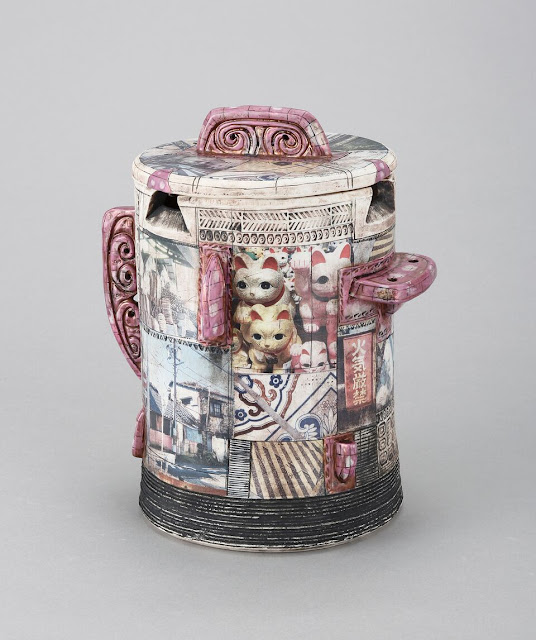 |
| Work made during the residency: Setomonogatari 1 (2015), porcelain, decals, pink lustre.
Photo: Seto City Cultural
Promotion Foundation, 2016.
|
 |
| Work made during the residency: Setomonogatari 4 - Fortune (2015), red clay, porcelain, mixed media, decals. Photo: Seto City Cultural
Promotion Foundation, 2016.
|


