Showing posts with label mchugh. Show all posts

Monday, March 9, 2015

Viva display at Sunderland Museum & Winter Gardens

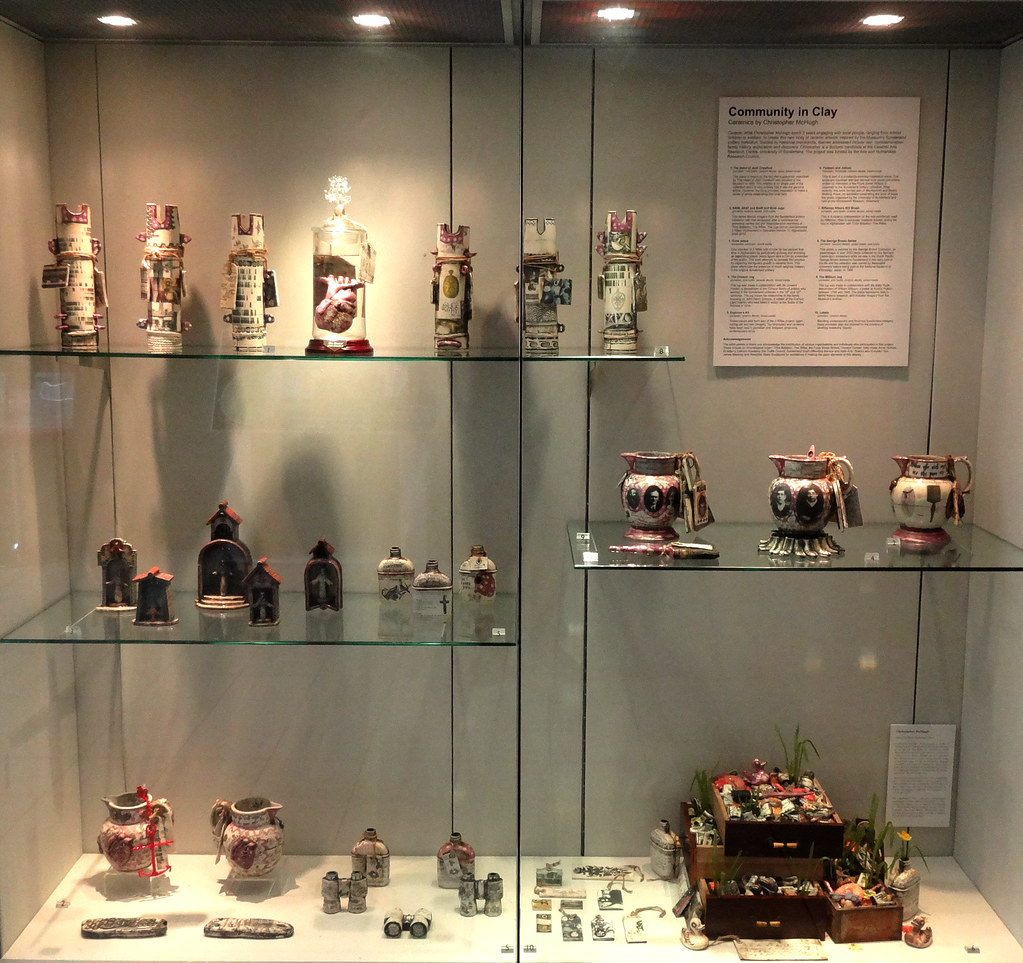
I displayed a selection of my artwork in Museum Street, Sunderland Museum & Winter Gardens, to coincide with my PhD viva voce examination on 6th February 2015. The exhibition ran until 8th March. It was great to have the display in such a prominent location in the museum and I was stopped a number of times by intrigued visitors while I was setting up.

The examination team was Prof. Stephen Dixon (Manchester School of Art, external), Dr Jeffrey Sarmiento (University of Sunderland, internal) and Prof. Peter Smith (University of Sunderland, chairman).


Community in Clay Christopher McHugh
The 'Community in Clay' display in Museum Street, Sunderland Museum & Winter Gardens. Photograph copyright of Christopher McHugh, 2015.

Monday, August 13, 2012

Firing Up exhibition at Sunderland Museum & Winter Gardens

An exhibition of ceramic artwork made by students from several local secondary schools as part of the Crafts Council’s Firing Up scheme is currently on display in Museum Street at Sunderland Museum & Winter Gardens (SMWG).  Firing Up is a national programme which aims to reinvigorate the teaching of ceramics in secondary schools. The project links schools with local university ceramics departments in order to create a sustainable infrastructure for skills exchange and education. The North East cluster was co-ordinated by Dr Andrew Livingstone, subject leader for ceramics at the University of Sunderland and leader of CARCuos, the Ceramic Arts Research Centre at the same institution.
Andrew also led ceramics workshops with staff and students at Wellfield Community School, while Robert Winter, ceramics technician and maker, together with CARCuos Artist in Residence, Katherine Butler, worked with Farringdon Sports Community College, Sandhill View Community Arts School and St Bede's Catholic School and Sixth Form Centre. I worked with approximately twenty Year 8 students and two members of staff from St Aidan’s Catholic School, Sunderland. Several undergraduate students from Glass and Ceramics also supported these sessions. Each school benefited from 4 full-day workshops delivered by a maker, as well as twilight skill-building sessions for the teachers run by Robert Winter at the National Glass Centre. Many of the schools will also receive Crafts Council funding to renew or refurbish their kilns, enabling them to continue using clay in their curriculum after the project has ended.
An important aim of the scheme is to demonstrate to school students how working with clay and ceramics can lead to a viable career and each maker adopted their own distinct approach to the project, reflecting their professional and creative interests. I was keen to incorporate my involvement in the project into both my PhD research and my wider artistic practice. After consultation with Alanna Nipper, St Aidan’s art teacher, I decided to adapt the ‘Tags, Tabs and Traces’ local mapping project suggested by Clayground Collective and the Crafts Council. Our project was loosely called ‘My Sunderland, My Museum’ and the participants were invited to initially make clay stamps and press moulds from personal items and found objects brought in from home. From these stamps, a series of ‘labels’ and ‘plaques’ were created. Finally, the students made a decorated slab-built box in which they could store the original items used to make the stamps, as well as any other personal ephemera, thereby creating their own miniature ‘museum’.
During the course of the project, Marie Harrison, SMWG's Assistant Learning Officer, led a session in the museum's Pottery Gallery, where my students enjoyed handling a range of objects from the handling collection before being sent on a treasure hunt around the museum to find iconic images and objects connected to Sunderland. The trip ended with a sketching activity back in the Pottery Gallery. It was intended that the visit would provide the students with an insight into the varied collections in Sunderland, with particular emphasis on the Sunderland pottery, which would inform the practical work they were making in the ceramics workshops. Knowing that their work was soon to be displayed in the museum, the students certainly seemed to enjoy the trip, their only complaint being that it was too short. Some students, taken with the 'frog mugs' on dispay, made their own versions back at  school, using slip-trailing techniques, inspired by other items in the collection, to decorate them.
Andrew’s approach was to spend the initial sessions focusing on developing basic clay skills which enabled the students to make work inspired by the architecture of their school.  Robert and Katherine’s students produced collage-like pieces combining textures, modelled elements and surface imagery.
Firing Up St Aidan's Year 8Detail of work made by Year 8 students from St Aidan's Catholic School, Sunderland
The exhibition opening and North East Cluster Celebration event was held on Friday 13th July and, according to Tony Quinn, Firing Up Project Co-ordinator, was the best attended event so far. The exhibition will run until 13th September, 2012.

Christopher McHugh is an AHRC Collaborative Doctoral Award PhD student based at the University of Sunderland and Sunderland Museum & Winter Gardens.

Thursday, July 19, 2012

What's Your Story? Discovering Family History - The Milburn Jug

hen I heard that What’s Your Story? Discovering Family History, a Tyne & Wear Archives & Museums travelling exhibition, was coming to Sunderland Museum & Winter Gardens (SMWG), I was keen to get involved. As an artist working with this venue’s  collection of Sunderland pottery, I was interested to use this opportunity to explore links between the collection and the wider community of Sunderland through my creative ceramics practice.
In a previous exhibition, Kith and Kin: New Glass and Ceramics, held at the National Glass Centre earlier in the year, I had curated a cabinet of original Sunderland pottery alongside documents from the ‘Scott archive’, a collection of paper ephemera from the Southwick Pottery (1788-1897) I had re-accessioned as part of my research. Addressing the title of the exhibition, my display aimed to highlight the family aspect of the production and consumption of Sunderland pottery, demonstrating through objects how it had often been made by several generations of the same families. I also wanted to show how it had been used to commemorate and celebrate family events like births, deaths and marriages. New ceramic work, made in collaboration with members of the Sunderland community, was also displayed in order to establish a dialogue between the past and the present, exploring how ceramic objects have and can be used to commemorate personal and wider narratives.
The Crinson Jug
The Crinson Jug with added labels.

As discussed in a previous blog, Howard Forster, a visitor to the exhibition, recognising some of the documents in my display from his own family history research, contacted me and we decided to make a new object which celebrated his family history through reference to his ancestors’ involvement in the Sunderland potteries. My blog about the Crinson Jug, led to an e-mail enquiry from Sally Hyde, a British-born, New Zealand-based occupational therapist whose fourth great-grandfather, William Milburn, had also been a master potter at Southwick Pottery. Further investigation of the ‘Scott Archive’ revealed a letter addressed to the Durham Agricultural Society dated 1845 showing that William started working at Southwick Pottery in 1788 and continued for 57 years. Milburn would have been a contemporary of William Crinson and his son, Robert, who started working at Southwick in 1788 and 1817 respectively.
For my contribution to the What’s Your Story exhibition, I decided to make a further jug to celebrate this connection as well as Sally’s quest to trace her family tree. This jug, which utilises much imagery collected by Sally on her ‘journey’ has been displayed in a desk case alongside the Crinson Jug and associated archive materials relating to the Milburns and Crinsons, including the above letter, Mark Crinson’s indenture and a letter from Robert Crinson, Mark’s nephew and William’s great grandson. The Crinson Jug has been ‘updated’, by the addition of ceramic labels printed with photographs of Howard Forster, his son and grandson. Interesting for me was the process of making the Milburn Jug which was negotiated remotely through e-mail correspondence and access to Sally’s Ancestry.com guest account. Sally has written a story about her own family history research which can be viewed on the What’s Your Story? website.
The Milburn Jug
The Milburn Jug

How an engagement with creativity, whether it results from tracing one’s family tree or crafting new objects, can help to define one’s identity and sense of self, a theme which has emerged through my recent ceramic practice, also appears to be a wider concern within academia and society. This is well illustrated by Sally’s experience of tracing her family history which seems to have helped her to cope with living far away from her family roots:
I was living in New Zealand and the whole process of creating the next generation started me thinking, and wanting to know about who had gone before. I have lived in New Zealand since 1986; I often feel the distance and a loss in so far as hearing family stories and family information, and this became more acute after the birth of my daughter. We visited my parents in the UK in 2000 and together with my mother began to investigate the past.
Similarly, an ability to empathise with her potter ancestor has helped to guide her own pursuit of making and collecting ceramics:
The knowledge of a Master Potter in my ancestry was great news to me as I have been working at an adolescent mental health unit as an Occupational Therapist for two years since my return to New Zealand in 2010. I have discovered a keen interest in pottery. My work is of a very amateur level, but I like to think that William guides me, and that my DNA assists too.
I don’t have any knowledge of what pieces of pottery William Milburn was involved in creating. I would love to have more information, but am not sure how to obtain this information or even know if it is obtainable. I have since purchased some Sunderland lustre ware pieces of pottery and would like to add more to my collection. I am especially interested in the pieces with a nautical theme which, for me, is inspired by my ancestors that follow from William Milburn who were sea farers. There is a family tendency to sail to foreign shores.
My intention with both jugs was to use relatively ephemeral information from digital photographs and scanned original documents to create enduring, dramatic material focal points or ‘micro-sites’ for commemoration and reflection. Family histories are often lost or not fully passed down the generations. These jugs are attempts to explore how ceramics can be used to preserve such fragile histories through a creative articulation of past and present. The degree to which translating Sally’s and Howard’s research into material objects has helped them to reflect upon their personal histories and how engaged they have felt in the creative process are perhaps questions I can reflect upon as part of my research.
What’s Your Story? offers an example of how museums can respond to the grassroots preoccupations of their visitors, empowering them to frame their own histories through the creation of dialogues between personal stories and items in the collection. The role the craft practitioner can play in the encouragement and mediation of this creativity, especially with reference to a collection, provides rich potential for innovative research. The combination of object making activities and museum display with digital participatory media leads to the possibility of the collection, the community and the artist being linked virtually as well as materially.
Did any of your ancestors work in the Sunderland potteries? Do you own or collect Sunderland pottery or do you know someone who does? If so, we’d love to hear from you.
Read more about the Crinson and Milburn families on the What’s Your Story? website: www.whatsyourstory.org.uk. What’s Your Story? Discovering Family History runs until the 27th August, 2012 at the Sunderland Museum & Winter Gardens.

Christopher McHugh is an AHRC Collaborative Doctoral Award PhD student based at the University of Sunderland and Sunderland Museum & Winter Gardens. Read more about his project at www.communityinclay.org.uk.
Monday, May 9, 2011

Gallery of Wonder Exhibition at the Great North Museum: Hancock

The Heart of Jack Crawford: A Shrine to Unsung Heroes, my solo exhibition of recent ceramic pieces, will open on Saturday 14th May PM in the Gallery of Wonder cabinet at the Great North Museum: Hancock. The venue is also taking part in The Late Shows. The show ends on 10th June.

Click here to see brochure.


Living Fossils: Art as archaeology, archaeology as art.
My work concerns the convergence of art and archaeology and often results in the creation of ‘living fossils’, or ‘fossils of life’, in which experiences, journeys and memories are preserved and monumentalised, in material form. This cabinet installation investigates, through porcelain, the idea of inventing a fictive material culture of relics from an imagined or lost civilisation. Incorporating imagery and text yielded through my research on Sunderland pottery, further inspiration has come from my own childhood collection of toys, Eskimo ivory carving, scrimshaw and other folk art.
Much cultural information, once recorded in material form, is now often stored or expressed electronically, leading to the “dematerialisation of the material world” (Renfrew 2003, p.181) and the possibility that many of the symbolic elements of our culture might become lost in the future. The aim of my doctoral project is to explore how the enduring nature of ceramic can be applied to this issue in order to form a means of enduring “external symbolic storage” (ibid., p.188). If, as Gell (1998, p. 222 cited in Layton 2005, pp. 29-46) argued, our consciousness is materialised in the objects we leave behind, a museum collection can be seen as a library of our ancestors’ thoughts, hopes and preoccupations. By responding to a collection, an artist can simultaneously reference the past and create new material traces. Not only does this augment the collection, but, by having the power to “fascinate, compel, and […] delight the spectator” (Gell 1998, p. 23), these artefacts also have the potential to act as a store of the creator’s agency into the future. 
Gell, A. 1998, Art and Agency: An Anthropological Theory, Clarendon Press.
Layton, R. 2005, Structure and Agency in Art in B. Derlon Lavollée, M. Coquet and M. Jeudy-Ballini (eds.) 2005,
Les cultures à l’œuvre: rencontres en art. Paris: Adam Biro, pp. 29-46.
Renfrew, C. 2003, Figuring it Out: Figuring it Out: What are We? Where Do We Come From? The Parallel Visions of Artists and Archaeologists, Thames and Hudson.