Tuesday, May 31, 2016

Community in Clay - Enterprise Place Membership

Following on from my AHRC Cultural Engagement Fellowship at the University of Sunderland, I have joined the University’s Enterprise Place start-up support scheme to develop my socially-engaged ceramics practice.

Addressing the NHS’s ‘Five steps to mental wellbeing’ and the Government’s recent Culture White Paper, the Fellowship aimed to investigate how an engagement with creativity and making might promote a sense of wellbeing by encouraging social interaction and active participation in the learning of new skills. As part of this, I developed a ceramics workshop programme for clients of Forward Assist, a leading charity supporting military veterans in north east England. These workshops were held in association with the National Glass Centre. Alongside this, I have been working as an artist associate of Equal Arts’ Hen Power Project, where I have been using clay and ceramics as a way to engage people suffering from dementia in residential centres in the North East.


These experiences of working with clay in a community setting have inspired me to explore this aspect of my practice as a socially engaged business and I will now be trading as Community in Clay. 

Alan and Colin of Forward Assist applying decals to their fired ceramic works. 

Sunday, May 1, 2016

AHRC Cultural Engagement Fellowship

Between February and April 2016, I was an AHRC Cultural Engagement Fellow based at the National Glass Centre, University of Sunderland. Capitalising upon my doctoral research, this project involved devising and delivering a ceramics workshop programme in collaboration with the National Glass Centre and Forward Assist, a charity supporting military veterans in the North East. The project explored what role ceramic practice might play in commemoration and wellbeing and I supported the veteran participants to make their own ceramic work. 

Veterans Colin, Alan and Peter decorate mugs with decals based on their respective regimental cap
badges and tattoos.

Tuesday, December 22, 2015

Seto International Ceramics and Glass Art Exchange Program 2015

Between November and December 2015, I was ceramic artist in residence as part of the Seto International Ceramics and Glass Art Exchange Program 2015. 

I regard my art practice as a form of research through which I interact with particular sites, communities or historical museum collections. Taking part in the programme enabled me to participate in a community with a rich and living tradition of ceramics production.

All over Seto, there are signs of its long and continuing engagement with clay and ceramics. During the residency, my accommodation was located next to a clay quarry and I used locally produced porcelain and red clay to make my work. Abandoned, crumbling ceramics factories exist alongside going concerns, and almost everywhere you go, broken sherds of pottery can be found under foot. On visiting the excavated Konagaso kiln site, I was moved when I found fingerprints impressed into a clay kiln support fired some 500 years old. While the often heavily weathered buildings and shop signs were a nostalgic reminder of Seto’s heyday, meeting artists and visiting factories showed that the city is still a vibrant centre of making.

The Setomonogatari series was inspired by this sense of continuity and change, particularly as expressed through material culture and the built environment. Discarded ceramic objects have been recovered and incorporated into new work. An old plaster mould has been reused, bringing it back to life and highlighting its silent story of person-object interaction. The three wall pieces were made with a plaster press mould taken from a piece of rusty corrugated iron, a building material ubiquitous in Seto. In creating a piece of ceramic art, we are making a material offering which has the potential to endure into the future, intact or as sherds. I documented my time in Seto through photography, often uploading images to Instagram. Many of these photographs were used to make ceramic decals which decorate the works, especially the porcelain pot and ema labels. By turning this digital information into lasting, solid forms, I hope that these works will preserve and tell the story of my time in Seto – my setomonogatari – as well as pay homage to the place and its people.

私は、特定の場所・コミュニティ・美術館の歴史的収蔵品などと対話をする研究の一様式として、自分の作品制作を位置づけています。瀬戸国際セラミック&ガラスアート交流プログラムを通して、私は、陶磁器生産が盛んで現在も息づく伝統あるコミュニティに身を置く機会を得ることが出来ました。

瀬戸には、時代を通して常に土や焼き物との関わりがあった痕跡が、町中にあります。滞在期間中、私は粘土採掘場の隣にある寮に住み、地元のポーセリンと赤粘土で作品を作りました。稼働中の工場の脇に、打ち捨てられた崩れそうな製陶場があったり、どこへ行っても足元には壊れた焼き物のかけらがありました。小長曽陶器窯跡を訪れた際は、窯の支柱となる粘土塊に押し付けられた、およそ五百年前の手指の跡を見て心を動かされました。町中の色褪せた看板は賑やかだった瀬戸を懐古的に思わせるものでしたが、一方で、現代の作家たちに会い、地元の工場を訪れると、確かにここは、今も活力に満ちた制作の中心であることがわかりました。

瀬戸物語』は、物質的文化や街並みから感じ取った、連続性と変化の感覚から生まれた作品です。捨てられた焼き物たちが、拾われて新しい作品に組み入れられています。古い石膏型が、再び使用されることで型としての命を吹き返し、人と物との間の物言わぬ対話に光があてられています。三点の壁掛けの作品は、町に遍在した錆びたトタン板から石膏型を取って、それに粘土を押し付けて作りました。陶芸作品を作るということは、あるいは破片になってしまったとしても、未来に遺る可能性のある物質を作るということなのです。私は、瀬戸での時間を写真によって記録し、たびたびインスタグラムに投稿しました。これらの画像から転写シートを作り、特に磁器の器と絵馬の作品の表面に写真を焼き付けました。デジタル情報を実際の物質に作り替えた私の作品によって、私が過ごした瀬戸の話―私の瀬戸物語―が保存され、また、この土地と人々への表敬となることを願います。

Work made during the residency: Setomonogatari 1 (2015), porcelain, decals, pink lustre. 
Photo: Seto City Cultural Promotion Foundation, 2016.

Work made during the residency: Setomonogatari 4 - Fortune (2015), red clay, porcelain, mixed media, decals. Photo: Seto City Cultural Promotion Foundation, 2016.


Thursday, June 18, 2015

Objects in Motion: Material Culture in Transition

I exhibited work from the George Brown Series as part of Objects in Motion: Material Culture in Transition, an interdisciplinary conference held at the Centre for Research in Arts, Social Sciences and Humanities (CRASSH), University of Cambridge, 18-20 June 2015. My display in the Alison Richards Building will continue until September.

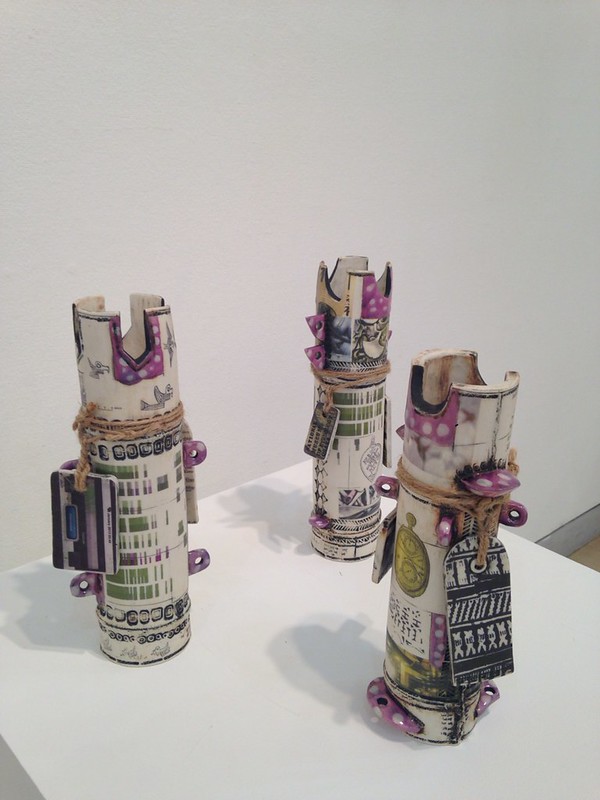
The George Brown Series is a group of ceramic vessels made in response to the George Brown Collection which I researched as part of an AHRC international placement at the National Museum of Ethnology (NME) in Osaka,  Japan. George Brown accumulated over 3000 ethnographic specimens while serving as a missionary in Oceania between 1860 and 1907. Described as ‘one of the most mobile collections in the world’, it has had a number of homes over the years, exercising the endeavours of a variety of people.

The George Brown Series was inspired by my research at the NME which focused on ‘transitional’ artefacts, in which influences from both the originating community and the European colonisers were manifest. A series of bamboo tubes from the Solomon Islands scrimshawed with scenes of European and indigenous encounters were of particular interest as they reminded me of some of the maritime imagery I was familiar with from my work on nineteenth century Sunderland pottery. These items spoke of the ‘creolization and hybridity’ characteristic of the colonial experience.

My porcelain vessels collage a range of visual and contextual information in order to communicate something of the collection’s complex history. Dutch traders took Sunderland pottery to Japan and it is not inconceivable that some pieces might have made it to Oceania. The George Brown Series exploits this conceit, imagining what a fusion of Solomon Island lime containers and Sunderland pottery might look like filtered through twenty-first century Japan.

Read more about the George Brown Collection here.

A selection of porcelain vessels from the George Brown Collection (2013-15).


A detail of my display at the Alison Richards Building, University of Cambridge.

Instagram image of my installation at the Alison Richards Building, University of Cambridge.


Monday, March 9, 2015

Viva display at Sunderland Museum & Winter Gardens

I displayed a selection of my artwork in Museum Street, Sunderland Museum & Winter Gardens, to coincide with my PhD viva voce examination on 6th February 2015. The exhibition ran until 8th March. It was great to have the display in such a prominent location in the museum and I was stopped a number of times by intrigued visitors while I was setting up.

The examination team was Prof. Stephen Dixon (Manchester School of Art, external), Dr Jeffrey Sarmiento (University of Sunderland, internal) and Prof. Peter Smith (University of Sunderland, chairman).


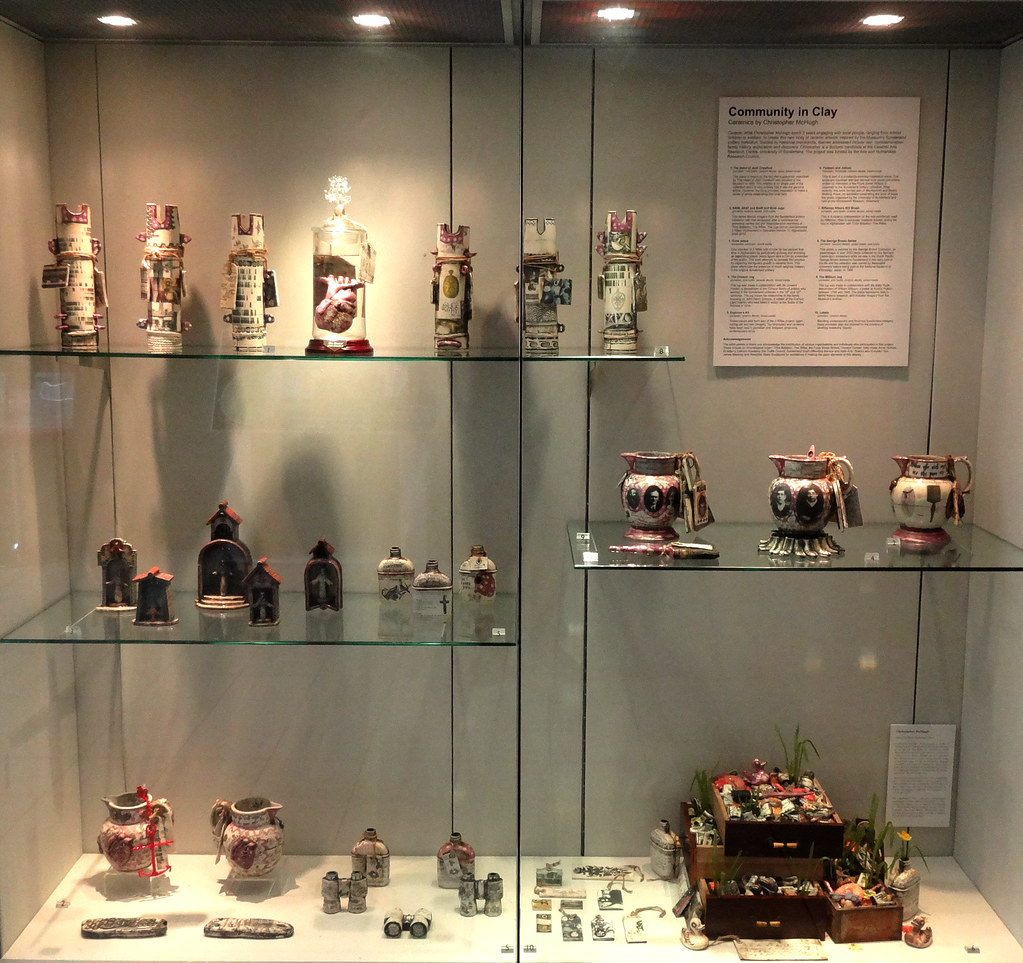
Community in Clay Christopher McHugh
The 'Community in Clay' display in Museum Street, Sunderland Museum & Winter Gardens. Photograph copyright of Christopher McHugh, 2015.

Saturday, May 24, 2014

Wordsworth and Basho: Walking Poets

My work is currently on show at the Wordsworth Museum, Grasmere, as part Wordsworth and Basho: Walking Poets, an exhibition inspired by the work of these two poets. Curated by Dr Mike Collier and Janet Ross, a number of contemporary artists and a composer have responded to original manuscripts by Dorthy and William Wordswoth and facsimiles of haiku by Matsuo Basho, which are also on show.

Flotsam and Jetsam (Portmanteau), 2014, by Christopher McHugh. Porcelain, terracotta, soda glass, mixed media. Photograph copyright of Colin Davison, 2014.


A detail of Flotsam and Jetsam (Portmanteau), 2014, by Christopher McHugh. Porcelain, terracotta, soda glass, mixed media. Photograph copyright of Colin Davison, 2014.


Background to my work

My installation, Flotsam and Jetsam (Portmanteau), is inspired by a verse from Wordsworth’s The Ruined Cottage and a haiku from The Narrow Road to the Deep North composed by Basho when he visited the ruined castle at Hiraizumi, Iwate Prefecture, in 1689. The piece aims to compare and contrast both poets’ approach to memory and the ephemerality of the human condition. While Basho’s works often revisit remains, former battlefields and other sites of communal memory, Wordsworth was concerned that human endeavour – both monuments and works of literature – were at risk of destruction through catastrophe and would be outlasted by nature. According to Aleida Assman (2011:94), ‘Discontinuity, loss and posteriority are integral to Wordsworth’s view of the human condition. Although Nature is divine and everlasting, culture is under constant threat of decay and irretrievable loss.[…] Humans rely on tradition, and whatever they create, invent, or compose is in danger of being forgotten.’


This preoccupation is aptly demonstrated by the scene in the The Ruined Cottage when the walker meets an old man resting amongst the ruins of what was once a family home. The itinerant tinker imparts the following:


 [...] We die, my friend.

Nor we alone, but that which each man loved

And prized in his peculiar nook of earth

Dies with him, or is changed, and very soon

Even of the good is no memorial left.

(The Ruined Cottage, verses 68-73)


The cottage and the quotidian narratives it once contained have been left to natural processes of decay. A cobweb hanging down to the water’s edge at the spring demonstrates that what once quenched thirst and ‘ministered’ to ‘human comfort’ has not been touched for a long time. The waters seem to mourn for the family and ‘the useless fragment of a wooden bowl’ is an index of this lost domesticity (verses 82-92).


A similar sensibility is evoked when Basho is moved to tears at encountering the overgrown and crumbling ruins of Lord Yasuhira’s house at Hiraizumi. The endeavours of three generations of the Fujiwara clan have ‘passed into oblivion’ to be reclaimed by nature: ‘When a country is defeated, there remain only mountains and rivers, and on a ruined castle in spring only grasses thrive’ (Basho 1966: 118). Basho composes the following haiku:


A thicket of summer grass

Is all that remains

Of the dreams and ambitions

Of ancient warriors


Both poets were also interested in disinterring for posterity the marginalised histories of the everyday folk – the flotsam and jetsam – they met on the road. Wordsworth writes in The Prelude:


No little band of yet remembered names

Whom I, in perfect confidence, might hope

To summon back from lonesome banishment,

And make them inmates in the hearts of men

Now living, or to live in times to come.

(The Prelude, 1805, I, 172-176, cited by Assman 2011:89)


Applying the immutable medium of ceramic to investigate and dramatise potentially overlooked narratives and materialise that which otherwise might remain absent or unconstituted is also a theme of much of the collaborative work I have done throughout the course of my doctoral research. While Wordsworth saw writing as a ‘frail shrine’ (The Prelude V, verses 45-49 cited in Assman 2011:195) and culture as fragile and fleeting, my work takes the premise that ceramic objects provide an enduring means of external storage through which contextual information, including text and imagery, can be preserved.


Flotsam and Jetsam (Portmanteau) is a re-working of an ever-growing installation piece consisting of hundreds of mainly slipcast and press-moulded ceramic components. This work began in 2011 as an installation of porcelain casts of Action Man boots as part of the group show, UnfinishedBusiness, at Wallington, a National Trust property in Northumberland. The exhibition coincided with the bicentenary of the birth of artist William Bell Scott (1811-1890) and my work referenced Scott’s painting, Iron and Coal, which depicts the halcyon days of Victorian industrialism. The boots, inscribed with text derived from a workshop with the Sunderland-based Foyle Street Writers, stood as a signifier of the absent presence of heavy industry in north east England, particularly on Wearside. The piece has subsequently been reworked several times, most notably at a solo exhibition at UAPS Gallery, Osaka, during my AHRC international placement in Japan, where I intended it would develop new resonance in the wake of the Tohoku earthquake and tsunami of 2011. In The Narrow Road to the North, Basho visits Ishinomaki, a fishing settlement which was badly affected by this disaster, before walking to Hiraizumi, the site of the ruined castle. This site is approximately 40 miles inland of Kesennuma and Rikuzentakata, both coastal towns devastated by the tsunami.

The inclusion of 'Portmanteau' in the title referes to Wordsworth’s portmanteau suitcace which is on display in Dove Cottage as well as alluding to Basho’s The Records of a Travel-Worn Satchel. A portmanteau is also a word formed through the combination of two or more other words, resulting in a new meaning. It is hoped that this piece will synthesise something of the essence of both poets, repackaging their words into a new object with contemporary resonances.


References

Cultural Memory and Western Civilization:Functions, Media, Archives, Cambridge: Cambridge University Press. 

Basho, M., 2005. The Narrow Road to the Deep North and Other Travel Sketches, New Impression edition., Harmondsworth: Penguin Classics (translated by Nobuyuki Yuasa, 1966).


Wednesday, September 4, 2013

Exhibition at Kookmin University, Seoul, Korea.

In July, three of my porcelain vessels from the George Brown Collection series were exhibited at Kookmin University in No Boundaries, an exhibition organised by its Graduate School. Slipcast work from several foreign makers was shown alongside that of a number of Korean ceramicists. Thanks to Jungwon Park, fellow PhD student at the Ceramic Arts Research Centre, University of Sunderland, for inviting me to participate.

My work is based on lime containers from the Solomon Islands which I studied while I was doing my research placement on the George Brown Collection at the National Museum of Ethnology, Osaka. Surface decoration is based on Instagram photographs I took to document my time in Japan as well as some of the traditional motifs from the lime containers. Other imagery is derived from  radiation readings I took everyday using a Radangel device I borrowed from Kromek in Sedgefield.

George Brown Collection Series, porcelain, glaze, pink lustre, ceramic decals, mixed media on display at the No Boundaries exhibition, Kookmin University. Photo courtesy of Kookmin University.
A view of the exhibition showing a variety of slipcast ceramic work. Photo courtesy of Kookmin University